Oral literacy and people ‘puppets’ made at the playdough table with the children after hearing the story of Sleeping Beauty’. There was a magnificent selection of loose parts made available by the teachers….. stones, pipe cleaners and toothbrushes!! and cinnamon play dough. Also a great example of a practice to encourage oral literacy. Descriptions and explanations are by the photos as you go through.
I made this when I sat down and was soon joined by a group of children. it is the castle and the entrance. Oh yes, the little sprigs of hebe were there too…….such terrifically imaginative and versatile bits and pieces.!
What was lovely to observe was the way a particular boy imitated the way I moved the king and queen around, all the time keeping up a conversation between them. Alas, I cannot remember it all!! but I loved it and he was a very versatile, articulate and cooperative ‘player’ who picked up ‘offers’ and accepted and then built on them.
Another child adds another person, with hat and a lovely skirt.
I think this was some sort of wizard brandishing a sword or wand…
The queen and her friend wanted to play in the park…and the arch was too small and apparently the castle was locked so I think we flew in….and played in the park.
Whoops! the gates to the park are locked…… and a dog is entering the script. How will they get out?
Every now and then the play dough would fall off, adding a complication to the plot about losing one’s trousers. This character lying down is in hospital, attended by the doctor…..
A hat has been discovered and worn by the queen but a wild wind blows it off her head…..
The dog chases after it .... the hat is sinking under the stormy seas. The dog leaps into the ocean to rescue the hat. My main player is hysterical with delight by this turn of events……..the plot is advancing rapidly. Other children are creating dogs and bowls and balls… ( great confusion there when I cannot hear the difference between ball and bowl…….and keep insisting that dogs don’t like bowls with nothing in them. I am amazed at how determined children are that I should understand….. extraordinarily dim of me because he was holding a sphere!! But such pleasure all round when I work it out….and such a wonderful innocent and accidental context in which to appreciate the similarity of vowel sounds!)
The dog bit the queen on her bottom and she has gone to hospital. Her dress fell off and so she is under a blanket.
Fashion conscious queen much recovered with a new and stylish hat.
A is for Africa where we first sat around fires and made meaning of our lives through telling stories about how the world was made.
B is for the Beginning when you Build a Bridge from this world into the world of story. ‘Once upon a time’ …or..’Before the beginning of time, before the beginning of everything, before there was a beginning…
C is for Children who are some of the world’s finest storytellers as well as story appreciators
D is for the fact that ‘the Destiny of the world is determined less by the battles that are lost and won than by the stories it loves and believes in’.
E is for Everywhere and Anywhere as being good places for a story to be told, not just mat time and bedtime or on the sofa.
F is for Family stories because they maintain a child’s sense of identity and belonging
G is for Giving it a Go and taking the risk of telling one of your own stories, family or made up.
H is for Handing over some of the storytelling props, opportunities and creativity to the children
I is for Imagination which is the foundation of creativity and the creation of anything new that ever was.
J is for Jesus who understood and used the deep irresistible power of storytelling when he shared his parables.
K is for Knowing your story before you begin , practising it while driving, stroking the cat or bathing.
L is for Language. Written literacy has its foundations in oral literacy. If you can’t find the way to tell a story how will you write the story ‘What I did in the summer holidays’.’
M is for Media which has become our main source of stories and usually the stories do not reflect the values we want for our children. So we need to take responsibility for them hearing better stories.
N is for neuroscientific research which shows that we learn best when we learn through a narrative: a story.
O is for the Opportunity (through storytelling) to gently broach delicate subjects obliquely, speaking to the heart rather than the head and offering images and metaphors to heal and resolve.
P is for Problem solving which can be explored collaboratively through storytelling.
Q is for Quiet before you begin, achieved with a rhythm, an unopened box, an expectant pause, a song, a music box…
R is for Relationship because when you live into a story and tell it, eyeball to eyeball, it is intimacy itself.
S is for Starting with simple stories and building up a repertoire slowly. Children are not judgemental.
T is for Temperament. Don’t forget to include qualities in your stories for all the temperaments.
U is for Using your voice with moderation . Children have vivid imaginations and only need for you to see the story in your own mind’s eye. It is easy to overwhelm with too much drama or volume.
V is for Vocabulary which can be extended so deliciously. Adjectives don’t get much of a look in during daily routines. Voluptuous, venomous, voluminous, vow, vault, vast, vermin…all veritably versatile verbiage for storytelling and after the age of two and a half, many children need to hear a word only once to ‘get’ it.
W is for Weaving wonder and offering a child a chance to dream into different worlds.
X is for X-box and TV and CD and DVD, all of which are machines. A story told by a human being brings warmth, connection and a sense of well being. Especially if you cuddle up at the same time.
Y is for You, because when you tell a story, you give part of yourself as a gift to the listeners, whilst simultaneously being fed yourself.
Z is for ‘Zip Zap Zest, now my story is laid to rest ‘
Whenever I am in a centre and want to tell a story with table top puppets, there is invariably a problem that all the two legged characters behave as though they are permanently inebriated, There are the cute family dolls with bendy bodies and large wooden feet and, with a chair or a wall, they can cope relatively well. But there they must stay.
Then there are the Lego characters who have large heads and smallish feet and cannot maintain their balance without a vehicle to prop themselves up in. Steiner dolls are great at standing for the most part but they don’t survive very well with children reared on indestructible plastic toys. Also they usually tend to be girls because their flared bodies lend themselves well to a skirt shape. And of course they have no feet. But this is surmountable with some imagination. Which children usually have ten fold or more. Read More
Some storytellers use no props at all; they use only the combination of their voice, their delivery, the story itself and the imagination of the audience, and that is the way story telling has been done since time immemorial. And as Jonathan Gottschall said in his wonderful book, ‘The storytelling animal: how stories make us human’, this sort of storytelling can be quite sexy ( see the admiring gaze of the young woman to the left of the story teller)!
However, in the context of early childhood education, as opposed to being told a story in the arms of one’s loving parent, there are good reasons to add props of some sort. Key protagonists in the story can be triggers to a child’s memory of the sequence and pattern of a story. ‘Oh yes, then there was the man with the bundle of straw’.
(Maybe if I had had props, I might have stayed on topic…. my apologies in advance, for meandering.)
Often, in my experience, a centre may have a small kete with the laminated characters of a story – Mrs Wishy-Washy, the tub, the animals, etc. – and if the children are lucky they have access to these at times other than mat times. The children will often play the role of ‘teacher’ and tell the story to other children, while manipulating the plastic pieces. Often this is a performance rather than as something that pleases a child to play with on their own.
I prefer to have three dimensional objects, ideally of a natural material, as well as aesthetically pleasing and texturally satisfying to hold. Why?
They offer the equivalent benefits as a basket of items for heuristic play. Sensory stimulation, and appreciation for the shape, feel, warmth, weight, balance, colour and texture of a ‘prop’.
After telling a story a number of times, using these props, I like to make the items available on the story table or nature table. Here, inviting fabrics, loose parts such as stones, shells and crystals, as well as the story characters, invite the children to retell the story in their own way. Story telling and play are first cousins.
an invitation to play/ tell a story
New characters, places, events, and memories from home can be seamlessly woven into a simple plot through the medium of the child’s imagination. The laminated ‘set’ allows for no extra characters such as a dirty and uncooperative Mr Wishy Washy, or another ten animals, or a dinosaur. Such additions can add complexity to the plot, requiring imaginative problem solving.
More than one child can play at the same time. A story can be co-created, collaboratively rescripted. Again, this reminds of how older children often engage in dramatic play, with much discussion of how many Mummies there can be in a story or whether or not the baby can talk.
Having a small flower arrangement which is lovingly and visibly refreshed by a caring teacher adds the message that these things are precious and loved. This nature story table usually reflects the seasonal changes and includes small treasures from nature. Such a culture of care and respect for the various less robust props is something that can be achieved primarily by modelling from the teachers.
In mainstream centres, my practice has been to combine the nature table with the story table. Driftwood can create a fantasy landscape, along with other loose parts. Ideally a centre will have enough ‘people’, ( who can stand freely), enough loose parts, and enough beautiful fabrics for children to create their own stories as well as recreate ones they have been hearing ( more than once). I am reminded of the adult teachers at a story telling workshop who, when invited to find props for telling a story, wandered happily around the room with a basket, to all intents and purposes as absorbed as if it was ‘retail therapy’ with someone else’s credit card! In much the same way, children need choice and the ability to select and create.
Too often, it seems that teachers have the idea that 50 people. or 30 dinosaurs or 40 cars will be ideal for playing. Far from it. Usually a diverse selection of characters will appear in a story, each with their own different agenda, and this is often hard to find. I think it has to do with a slightly OCD attention to tidy storage. It reminds me of Diti Hill’s comment that ‘children do not live their lives in curriculum fragments’ and equally, stories are not conveniently told with large quantities of similar characters, selected by the teacher.
Three boys, previously preoccupied with shoving all the blocks off the table onto the grass, became involved alongside me in a story about hospitals and car accidents. Three small blocks in the ice cream box, on its side, became a hospital bed. The tip up truck became the ambulance, the woman with the missing foot was rushed off to hospital, and the woman’s son raced after him on his motorbike. The three boys added dialogue, sound effects, their own ideas, solutions to problems, unexpected changes in the plot and a stream of language – oral literacy, fine motor skills, and cooperative social skills, here we come!
Although an observer might consider that I was ‘just playing’ (and I was playing!) I would call this ‘teaching’ – scaffolding, modelling, allowing, inviting and generally adding one more brick to the wall of a story telling culture.


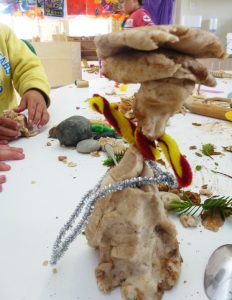 a wild wind blows it off her head…..
 The dog chases after it .... the hat is sinking under the stormy seas. The dog leaps into the ocean to rescue the hat. My main player is hysterical with delight by this turn of events……..the plot is advancing rapidly. Other children are creating dogs and bowls and balls… ( great confusion there when I cannot hear the difference between ball and bowl…….and keep insisting that dogs don’t like bowls with nothing in them. I am amazed at how determined children are that I should understand….. extraordinarily dim of me because he was holding a sphere!! But such pleasure all round when I work it out….and such a wonderful innocent and accidental context in which to appreciate the similarity of vowel sounds!)


