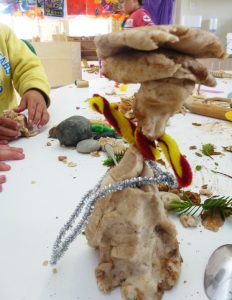
Sleeping Beauty with toothbrushes and playdough

Oral literacy and people ‘puppets’ made at the playdough table with the children after hearing the story of Sleeping Beauty’. There was a magnificent selection of loose parts made available by the teachers….. stones, pipe cleaners and toothbrushes!! and cinnamon play dough. Also a great example of a practice to encourage oral literacy. Descriptions and explanations are by the photos as you go through.

I made this when I sat down and was soon joined by a group of children. it is the castle and the entrance. Oh yes, the little sprigs of hebe were there too…….such terrifically imaginative and versatile bits and pieces.!


What was lovely to observe was the way a particular boy imitated the way I moved the king and queen around, all the time keeping up a conversation between them. Alas, I cannot remember it all!! but I loved it and he was a very versatile, articulate and cooperative ‘player’ who picked up ‘offers’ and accepted and then built on them.

Another child adds another person, with hat and a lovely skirt.


I think this was some sort of wizard brandishing a sword or wand…

The queen and her friend wanted to play in the park…and the arch was too small and apparently the castle was locked so I think we flew in….and played in the park.

Whoops! the gates to the park are locked…… and a dog is entering the script. How will they get out?

Every now and then the play dough would fall off, adding a complication to the plot about  losing one’s trousers. This character lying down is in hospital, attended by the doctor…..

A hat has been discovered and worn by the queen but a wild wind blows it off her head…..


The dog chases after it .... the hat is sinking under the stormy seas. The dog leaps into the ocean to rescue the hat. My main player is hysterical with delight by this turn of events……..the plot is advancing rapidly. Other children are creating dogs and bowls and balls… ( great confusion there when I cannot hear the difference between ball and bowl…….and keep insisting that dogs don’t like bowls with nothing in them. I am amazed at how determined children are that I should understand….. extraordinarily dim of me because he was holding a sphere!! But such pleasure all round when I work it out….and such a wonderful innocent and accidental context in which to appreciate the similarity of vowel sounds!)

The dog bit the queen on her bottom and she has gone to hospital. Her dress fell off and so she is under a blanket.


Fashion conscious queen much recovered with a new and stylish hat.

Ripping paper with the flamingo family

The Flamingo Spring Festival Party ( a story to teach children how to rip paper)

One fine spring morning, Mummy Flamingo gathered her two daughters to her side and said,” Look! It’s an invitation to a spring party! ( Have a very pretty envelope and pull out a piece of paper as you start to tell the story! ) We need to make some beautiful clothes to wear. Oh my goodness what shall we wear?”.

(ask children for their ideas about what to wear to a party…. Accept every offer and add some spontaneous reason why they would love to wear that and what game or dance it might be an ideal outfit for ….)

Let’s see what the flamingo family decide to make. But hang on!  there was a problem! Although there was lots of lovely silk and satin fabric to make some feathery clothes out of, something was missing. What would WE  use to cut cloth with ? That’s right, we might use scissors, but they didn’t HAVE any scissors. They had their beaks and their…. What do flamingos have on their feet, do you think?

(Be sure to accept offers of highheel stilettos, and cowboy boots! After all, they don’t talk either!… and simply ask what is underneath the flamingo cowboy boots. What have I got inside my socks? Toes!! Yes, well the flamingos have claws for picking up things and holding onto things. )

And they also had?( gesture with your hand a long sharp beak)….yes , their beaks which could rip and tear and grab and were good for all sorts of things! Any idea of what sort of things a beak could be good for……… scratching? Yes, especially those annoying itches right round by your wings, and eating, yes, and catching fish, yes…….and fighting with your sister? Absolutely, if push came to shove.

( This is basic imaginative problem solving and leaves room for ‘righter’ or ‘wronger’ answers. Which leaves children feeling empowered , as opposed to tested).

So there they were , with big sheets of pink silk, and no scissors and also they had no iron! So it was very important not to scrinkle and scrunkle the cloth because otherwise their party clothes would look very shabby indeed!

“Now”, said Mummy Flamingo, “ do you think you two girls could rip this cloth into nice straight strips for me?” and she left the room to ring up and tell their aunt about the party.

While Mummy was out of the room, her daughters thought they would be helpful . They were very excited about the party and keen to start.They each grabbed a piece of cloth with their claws, and tried to pull the cloth apart. Well! what a mess, Mummy was not pleased when she came back into the room!

( take a single sheet of newspaper, tabloid size, not the bigger one, and hold the paper long ways and pull the ends as you grab and then squeeze it tight in your grip and pull ( like you would  hold a  christmas cracker…………..then show the children what a scrunched up unripped cloth it was. )

Mummy Flamingo showed them very carefully the two ways that you can hold the paper in order to rip it into straight lines. From short side to short side, or from long side to long side.

( model this for the children. You will undoubtedly hold your pinched finger and thumb of each hand right beside the finger and thumb of the other hand. But simply focus on the concept of long and short. Even draw a rectangle on the white board……………?)

And so they learned from their oh so clever mother that cloth likes to rip short side to short side, making nice long strips. Mummy suggested that they work together on one piece this time, using their two beaks. So the girls had a go, but although they tore from short side to short side, and it no longer needed scissors ( which they didn’t have) it came off in such irregularly sized bits. Why couldn’t they do it the way Mummy did it? in nice long strips? They got such odd shapes and all different lengths and sizes. Again, Mummy came back and sighed. “Girls, we don’t have that much cloth. It’s true that our friends, the mice, could help nibble the edges straight and it’s true that Mrs Hippopotamus had offered to sit on the scrumpled pieces for a few hours for us, to flatten them, but we just don’t have that much time. The letter must have gotten lost in the mail, because it has arrived late and the party is tomorrow.

“Now, girls, watch very carefully how I rip the cloth”, and she showed them again. “Now, Esmerelda, take hold of the paper where you want it to rip, grip it firmly  on the edge with your beak. And now, Matilda, you come and stand right beside Esmerelda, but face the other way. Bunch up real close so that your cheeks and your shoulders are touching, and NOW, you walk towards me, dear Esmerelda, and you walk away from me, dear Matilda”. Don’t stop squeezing the paper tight in your beaks and keep going!

(model it with your hands, clearly showing the pinching right at the top of the paper. Squeezing the paper tight,. Get up real close together, and then hold your elbows up so they can really see your finger hold, and slowly rip down the strip. )

“Bravo! Wonderful! Spectacular! “shouted Mummy Flamingo. “Do it again! Do it again!” and they did. They ripped strip after strip after strip. Until they had a whole pile of strips, all about the same width and the same length……….( more maths and geometry)

“And now I shall start sewing!” she announced, gathering up all the strips. But, do you know, within a few moments, she came flapping back in again!

“Children, children!, I need your help. Your aunt was on the phone and everyone in the whole whanau wants to come too and we need many many many more strips of cloth. There simply isn’t enough time.

And her daughters said, “Let’s ask these children sitting so politely here on the mat. They have been watching and listening. I am sure they could help. Could you help? Do you know how to do it too?”

If any children say ‘yes’ ( and I think they will) then the daughters can say’” See, our troubles are solved. Here you children. Take a piece of cloth, and remember

1. Short side to short side.

2. Hold your finger beaks right beside each other on the very edge

3. Make your fingers walk: one towards your face and one away from your face!!

You will have a bit of a mess but they children have an opportunity to begin learning how to rip…. And in a way in which is sort of fun, sort of memorable, and sort of without pressure to get it ‘right’ hopefully.

The end.

The alphabet of storytelling

A is for Africa where we first sat around fires and made meaning of our lives through telling stories about how the world was made.

B is for the Beginning when you Build a Bridge from this world into the world of story. ‘Once upon a time’ …or..’Before the beginning of time, before the beginning of everything, before there was a beginning…

C is for Children who are some of the world’s finest storytellers as well as story appreciators

D is for the fact that ‘the Destiny of the world is determined less by the battles that are lost and won than by the stories it loves and believes in’.

E is for Everywhere and Anywhere as being good places for a story to be told, not just mat time and bedtime or on the sofa.

F is for Family stories because they maintain a child’s sense of identity and belonging

G is for Giving it a Go and taking the risk of telling one of your own stories, family or made up.

H is for Handing over some of the storytelling props, opportunities and creativity to the children

I is for Imagination which is the foundation of creativity and the creation of anything new that ever was.

J is for Jesus who understood and used the deep irresistible power of storytelling when he shared his parables.

K is for Knowing your story before you begin , practising it while driving, stroking the cat or bathing.

L is for Language. Written literacy has its foundations in oral literacy. If you can’t find the way to tell a story how will you write the story ‘What I did in the summer holidays’.’

M is for Media which has become our main source of stories and usually the stories do not reflect the values we want for our children. So we need to take responsibility for them hearing better stories.

N is for neuroscientific research which shows that we learn best when we learn through a narrative: a story.

O is for the Opportunity (through storytelling) to gently broach delicate subjects obliquely, speaking to the heart rather than the head and offering images and metaphors to heal and resolve.

P is for Problem solving which can be explored collaboratively through storytelling.

Q is for Quiet before you begin, achieved with a rhythm, an unopened box, an expectant pause, a song, a music box…

R is for Relationship because when you live into a story and tell it, eyeball to eyeball, it is intimacy itself.

S is for Starting with simple stories and building up a repertoire slowly. Children are not judgemental.

T is for Temperament. Don’t forget to include qualities in your stories for all the temperaments.

U is for Using your voice with moderation . Children have vivid imaginations and only need for you to see the story in your own mind’s eye. It is easy to overwhelm with too much drama or volume.

V is for Vocabulary which can be extended so deliciously. Adjectives don’t get much of a look in during daily routines. Voluptuous, venomous, voluminous, vow, vault, vast, vermin…all veritably versatile verbiage for storytelling and after the age of two and a half, many children need to hear a word only once to ‘get’ it.

W is for Weaving wonder and offering a child a chance to dream into different worlds.

X is for X-box and TV and CD and DVD, all of which are machines. A story told by a human being brings warmth, connection and a sense of well being. Especially if you cuddle up at the same time.

Y is for You, because when you tell a story, you give part of yourself as a gift to the listeners, whilst simultaneously being fed yourself.

Z is for ‘Zip Zap Zest, now my story is laid to rest ‘

King Solomon and the Baby.

Well, the interesting thing is that even though I have scrolled through google and youtube I have never found the slightly adapted version of King Solomon and the Baby, which inspired me so much when I was a teacher at the Steiner school. I was only a relieving teacher at the time and was new to much of Waldorf philosophy. There were some powerful young 9 year old girls in the class, and the Main Lesson of the time was the Old Testament and most of the curriculum  material was linked to various stories from that volume. The reasoning, as I understand it, is that the Steiner school curriculum follows the natural cycle of a child’s development , which not illogically follows mankind’s own evolution.

William Harrer says: It is a well-known fact that fairy tales have their origin in the period of humanity’s own childhood, in far-distant times when people lived in a naive dreamlike state of soul, before the unfolding of intellectual capacities. According to the principles of biogenetic law, children pass briefly through the different stages of mankind’s evolution. Children between the ages of four and eight correspond approximately in their development with that period of humanity’s childhood in which fairy tales originated. An unspoiled child absorbs fairy tales during this period of its life, with an eagerness similar to the hunger and intensity with which a baby absorbs its mother’s milk.

This  may sound far fetched but it makes sense to me. Class Two works with Main Lessons that match their soul mood: Fables, Lives of the Saints, The King of Ireland’s Son. The Steiner school in Hastings describes the eight year old’s experience of life thusTheir development is moving towards self identity and encompasses a growing awareness of others as different identities with their own needs and abilities. The world as it affects them is still the basis of the children’s primary social response. The eight year olds are now in the final stages of imitation; they will still be influenced by others actions however and adults must continue to be worthy role‑models and to set the standards for all social interactions. The will is still predominant and the healthy eight‑year‑old will wish to act out all experiences. The children wish to please those they love and to know the world as a good and beautiful piece and they implicitly trust that adults know what is right and good for them.

This is all a preamble for me to get to the story I want to share with you. I took over this class of children when they were in Class Three and turning nine. This is the ‘year of the Rubicon’ for many children, with a dawning awareness that they are separate individuals, that their mother cannot read their mind, that death happens, and that the world is bigger and scarier than they used to think. Metaphorically, it is a time when they begin to be cast out of the Garden of Eden, or childhood, and fittingly, the Main Lesson stories are taken from the Old Testament. My understanding is that children at this age are nourished by stories which tell them that the adults around them, their teachers and parents, are aware of all that is happening and are making wise decisions so that the child feels ‘held’ as they go through the ‘nine year old crisis’. It is  a bit reassuring to hear a story about Jehovah who is so damned sure of  himself. ‘And God said… and that settled it! And Mum said, …and that settled it’. By the following year, Class Four , the whole picture changes and a completely different set of stories form the backbone of the year’s Main Lessons. Such an interesting curriculum and so spot on the way it mirrored the needs, development and evolution  of the children. I prefer it to the fairly random way the mainstream curriculum is decided upon: Oh, let’s do Hitler or pollution,…. oh wait , we haven’t done outer space yet…….what about a bit of…..?

In Class Three ‘The children will question those things that previously went unquestioned: “Who are you to tell me?”, “What is my real name?”, “Am I adopted?” They will push boundaries, venture forth fearlessly when you wish they wouldn’t and shrivel up fearfully where once they were confident. With the ninth year there comes an important stage in the development of the growing child, and this should be carefully watched and considered in teaching and education. It is the age when the child first really feels separate from the surroundings, which formerly were taken so much for granted. Self-consciousness becomes noticeably stronger and the soul‑life more inward and independent’. See this link for more.

So we arrive at my story about a story. Finally. Well, it was a tricky day and I was new and nervous. A fight broke out between two factions in the classroom and weapons (one candlestick holder and one flute!) were drawn and things rapidly spiralled down into a situation which requirement some form of action. Disciplinary consequences? deciding who was righter and who was wronger? Calling in the parents and having a class meeting? Was I competent to teach this class ? (‘This age makes great claims on the wisdom and tact of the teacher’ says the article above. Too right it does).

I was in a quandary and very stressed and unsure how to proceed. The whole class (and the parents)  felt divided and fractious and vulnerable. I spoke to an experienced colleague who calmly suggested that since the Old Testament was full of stories which were soul food for this particular age, I should see if I knew a story which might fit this situation and address it through the metaphor of a story. I felt as though I knew NO stories from the Old Testament. Well, only apparently unhelpful ones like Davis and Goliath, Samson and Delilah or Daniel in the Lion’s Den ( which in some ways was a very appropriate story!)

My friend reassured me that if I ‘asked the angels’ ( I now would translate that into ‘trust my intuition and my own deeper wisdom’) before I went to sleep, I would probably find one. How hard it is to trust one’s higher self and not want to Google and research and look up ‘the right answer’! … by all means , jog one’s memory but then to be quiet and to trust the process.

Sure enough, I woke ecstatic because I realised that I DID know a story and that it was the perfect story. The extraordinary thing , however , was that it was me, rather than the children,  who most needed to hear the story. The metaphor of the story was so meaningful and it resolved so much of the apparent complexity of the situation, that I went up to school in my best clothes and I would have taken a cake if I could have because, rather than feeling as though I was walking into a potential snake pit, I felt as though I was going to a party.

I was at peace with  myself, with what had happened and with what I would do next.

I did not tell the story in the morning, I did  not refer to the incident, but in my very centre I was clear as a bell. Curiously, with the admonishing finger of authority apparently not about to manifest and complicate things, the children actually sent little notes to each other during the Main Lesson, saying sorry to each other. Things pretty much went back to normal and I believe it was because I, as a conscious adult in the room, was carrying a sense of resolution, thanks to the story,  even though I said nothing . In the afternoon, I finally told the story, and this is how my version went. (I am not sure where I found it because all the ones online have based it on the original which attributes the death of one baby to the fact that its mother rolled onto it at  night and then substituted the babies so as to still have one. A bit short.)

My version described two mothers who had children and loved them. In my version there was no mention that they were prostitutes. As their babies grew a little older, one started to ail and eventually died. The mother was heartbroken and in pity , the second mother allowed her sometimes to care for her infant. And so a friendship developed and sometimes the other mother would bathe the child, or walk the child or rock her to sleep. And so on and so forth.  However, as time went by the bereaved mother became so attached to the child that she started to say that it was actually hers and refused to return the child. I probably spun out the scenario and the feelings and the situations until eventually it was a sort of village crisis with everyone arguing, and no one able to sort it out. Finally, a wise older woman suggested ( it was probably a bloke when I told it… it is very hard to resist the impulse to sideline women!! I challenge you to notice if you do this.?) that they take the child to King Solomon as he was also very wise and ask him to sort it out. The childless woman had really begun to believe her own story and so they went. After  hearing from them both, Solomon said that the solution was simple and called for his sword. Raising it above his head, he announced that he intended to cut the baby in two and then they could both have half! The true mother immediately cried out, ‘ No,no. The baby is hers. Give the baby to her!” and then Solomon lowered his sword and gave the child to its real mother because then he knew the truth.

The children listened without interruption and we ended our day by shaking hands as each child left the room. What was particularly memorable and special was that the one girl who was a key ringleader and possibly provocateur numero uno of the whole debacle, stopped at the door, to share with me her vehement indignation  at how bad that second mother had been. The story had done its work. And I was in a state of awe.

This was really my first introduction to the power of story as a healing tool. And I still  marvel at the way the images, the metaphor, the parallel just addressed the whole of the situation in a way that logic and reason and a lecture could  never have begun to achieve. We could  have had a class meeting and dished out consequences but it would have meant splitting the baby, (our little class community) in two. It was not the right way.


The article below addresses the same idea of stories offering alternative  healing potential for parents struggling with difficult issues with their children :

http://goodmenproject.com/families/why-storytelling-is-way-better-than-lecturing-your-kids/